Have you ever spent a small fortune on luxury hair masks, only to feel like your split ends are still winning? You are not alone. Most of us were taught that hair care starts at the ends. We slather oils onto dead strands, praying for a miracle. But here is the truth: focus on the ends and you are completely missing the source.
Your scalp is not just skin under hair. It is a complex living ecosystem. Think of your scalp as soil and your hair as crops. If you plant seeds in dry, clogged, or inflamed soil, you cannot expect a lush harvest.
Inside your scalp are roughly 100,000 tiny hair follicles embedded in a blood-rich layer of skin. Each follicle goes through a natural cycle: a growth phase (anagen), a brief transition phase (catagen), and a resting or shedding phase (telogen). When your scalp becomes chronically inflamed or dirty, this cycle gets wrecked. Hair gets pushed into the shedding phase too early, leading to thinning and weaker growth.
The Anatomy of a Healthy Scalp
So what does a healthy scalp actually look like? When things are balanced, you won't even think about your scalp. There is no itching, no redness, no excess grease, and no visible flakes.
Behind the scenes, trillions of microorganisms live on your skin. This is your scalp microbiome. In a healthy state, friendly bacteria keep your skin slightly acidic with a pH between 4.5 and 5.5. These good bacteria make needed vitamins and protect against harmful invaders. At the same time, microscopic fungi live on your natural oil, known as sebum.
Sebum itself is a double-edged sword. In normal amounts, it keeps your hair soft and flexible. But when production goes haywire, things get messy
• Excess sebum: Feeds yeast, traps dead skin, and leaves hair greasy within hours.
• Too little sebum: Causes tightness, irritation, and a brittle texture.
• Oxidized buildup: Environmental pollution and heavy styling products mix with sebum, creating hardened plugs that smother follicles.
When you let heavy dry shampoos, hairsprays, and pollution pile up without proper cleansing, you create an environment where bad yeast thrives. This triggers irritation that weakens your hair right at the root.
Mastering Scalp Massage and Exfoliation Techniques
If you want stronger hair, you need to wake up your follicles. That is where targeted massage and mechanical care come into play.
When you rub your scalp, physical force changes cellular biology through a process called mechanotransduction. Research shows that just four minutes of standardized daily scalp massage over 24 weeks can significantly increase individual hair thickness.¹ Mechanical stretching sends direct biological signals to hair cells, boosting growth genes and turning down inflammatory triggers.
Here is a simple routine for an effective at-home scalp massage
1. Place your fingertips (not your nails) firmly against your scalp.
2. Apply moderate pressure and move your skin in slow, circular motions.
3. Work your way from your hairline, over the crown, down to the base of your neck.
4. Do this for four minutes every day, ideally before washing or while applying a light serum.
Exfoliation takes this routine a step further by clearing away stubborn debris. But you have to choose the right method
• Chemical exfoliants: Use active ingredients like salicylic acid or glycolic acid to dissolve dead skin cells and clear oil-filled pores without scrubbing. Dermatologists prefer this method because it cleans deeply without causing friction.
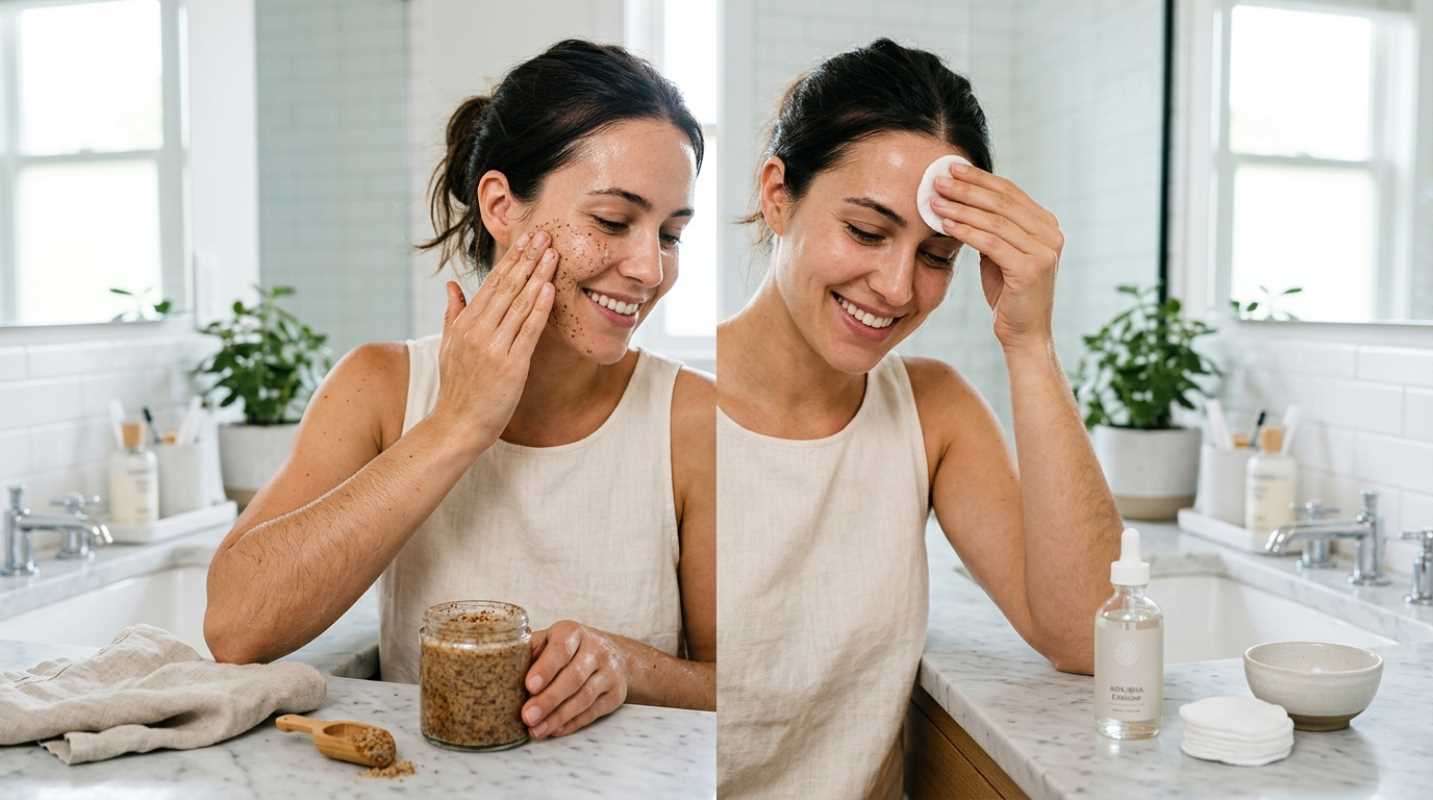
• Physical exfoliants: Use sugar, salt, or brushes to scrub away flakes manually. Although they give quick gratification, overdoing them can cause micro-tears in skin, leading to more oil production and sensitivity.
Clinical trials show that adding a targeted exfoliant can reduce visible flaking by over 60% while increasing measured hair thickness over time.²
Troubleshooting Treating Dandruff and Dryness
How do you know if you are dealing with dry scalp or true dandruff? It matters, because treating them requires different approaches.
Dry scalp means your skin lacks water and oil. Flakes are small, white, and dry. Dandruff, on the other hand, is usually caused by an overgrowth of yeast feeding on excess oil. Flakes from dandruff are larger, oily, and often yellowish.
When fighting dandruff and stubborn buildup, look for proven active ingredients on ingredient labels
• Salicylic acid: A lipophilic acid that penetrates oil-filled pores to dissolve dead cell buildup.
• Zinc pyrithione and piroctone olamine: Antifungal agents that calm yeast growth and lower scalp stress. A 24-week clinical trial found that regimens containing piroctone olamine significantly reduced hair shedding.³
• Selenium disulfide: A powerful antifungal ingredient that calms itching and restores microbial balance.
• Tea tree oil: A natural antibacterial and antifungal option for mild irritation.
Although at-home treatments work for everyday issues, know when to get professional help. If you notice severe redness, burning, bleeding, painful bumps, or sudden patch hair loss, stop self-treating. A dermatologist can diagnose underlying conditions like psoriasis, eczema, or severe seborrheic dermatitis.
Simple Steps to Build Your Scalp First Routine
Building a great routine does not mean adding ten new steps to your morning. It means shifting your focus to consistency.
Start with a dedicated shampoo that fits your specific needs. If your scalp gets greasy quickly, use a clarifying shampoo with salicylic acid once or twice a week. If you have a sensitive or dry scalp, choose gentle, sulfate-free cleansers that protect your skin barrier. Apply treatments directly to your skin, not just your hair lengths.
Remember, one deep treatment every two months will not transform your hair. Consistent, simple care every single week builds long-term hair strength. Cleanse thoroughly, give yourself daily four-minute massages, and treat your scalp with the same respect you give your face. Your hair will show the difference.
Sources:
1. Standardized Scalp Massage Increases Hair Thickness by Inducing Stretch Forces on Hair Follicle Cells in the Subcutaneous Tissue
https://pmc.ncbi.nlm.nih.gov/articles/PMC6369642/
2. Clinical Evaluation of a Hair Scrub and Serum Regimen
https://pmc.ncbi.nlm.nih.gov/articles/PMC10939504/
3. Novel Treatment Regimen May Slow Hair Loss, Promote Scalp Health
https://consultqd.clevelandclinic.org/novel-treatment-regimen-may-slow-hair-loss-promote-scalp-health
*This article on modernlifestyle is for informational and educational purposes only. Readers are encouraged to consult qualified professionals and verify details with official sources before making decisions. This content does not constitute professional advice.*